ReSemAct FrameWork
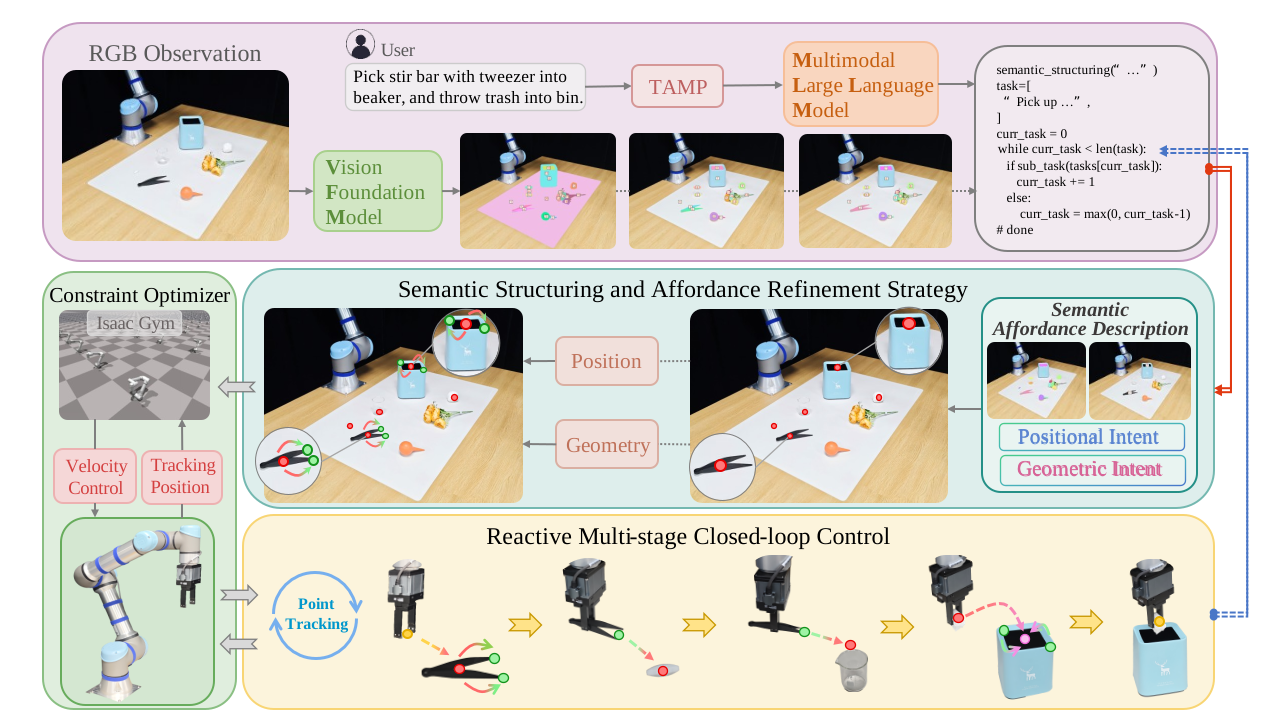
Framework. Given natural language instructions and RGB-D observations, the synergistic reasoning between VFM and MLLM facilitates the semantic structuring representation. Within the MLLM-driven TAMP framework, the Semantic Structuring and Affordance Refinement Strategy performs geometric and positional flow optimization over the Semantic Affordance Description, thereby generating the refined affordance targets. These targets are then encoded as cost functions and solved in real-time by a closed-loop MPPI-based optimizer in Isaac Gym, enabling joint-space control with point tracking.
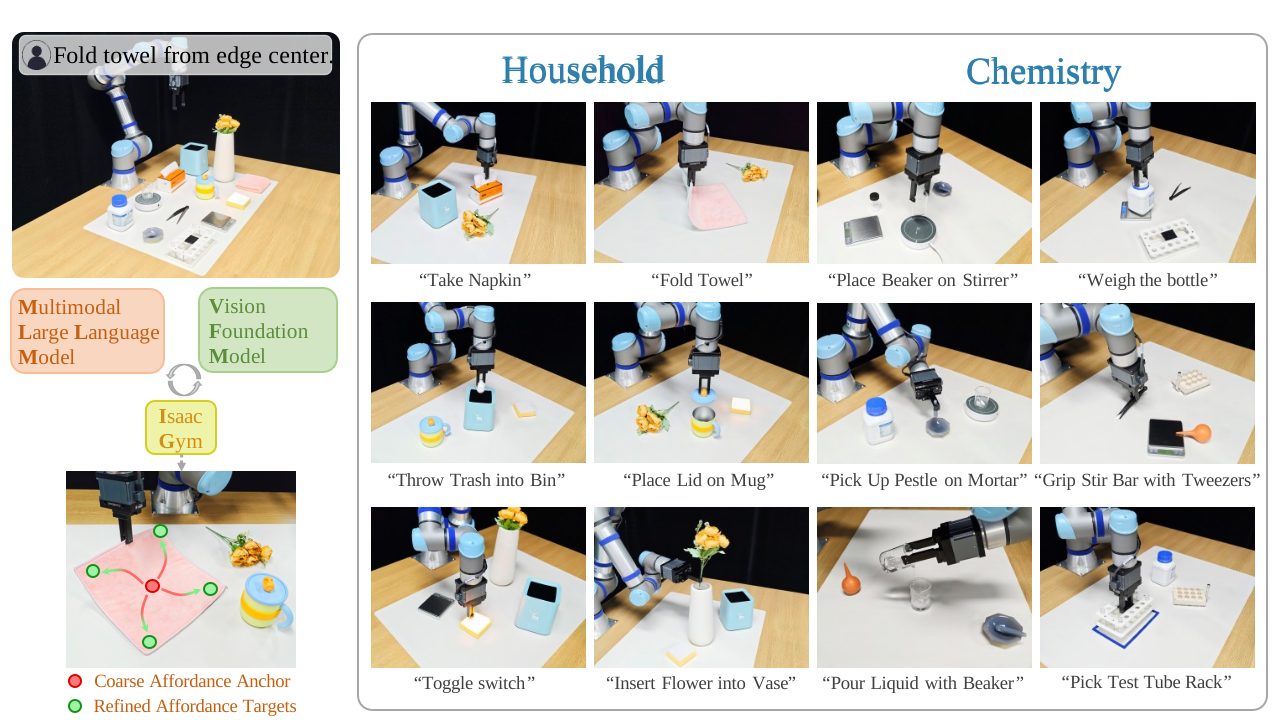
Task. ReSemAct is a unified robotic manipulation framework for semantically diverse environments. It leverages synergistic reasoning between MLLMs and VFMs, introducing Semantic Structuring and Affordance Refinement (SSAR) to enable fine-grained robotic manipulation.
Interactive Visualization (Simulation)
Interactive visualization 1
Interactive visualization 2
Interactive Visualization (Real-World)
Interactive visualization
Interactive visualization
Execution under Disturbances
Disturbance for Household Tasks
"Fold towel."
"Throw trash into the bin."
Disturbance for Chemical Lab Tasks
"Pick up pestle on mortar."
"Pour liquid with beaker."
Long-Horizon Task
🌟 With the SSAR and MLLM-driven Task and Motion Planning, ReSemAct shows strong potential for long-horizon tasks. It achieves closed-loop control through autonomous multi-stage task decomposition, combined with condition reasoning and cost optimization.
User Instruction: Please complete a magnetic stirring experiment involving liquid and stir bar transfer with an empty beaker and tweezers.
Step 1: Pick up the tweezers.
Step 2: Grasp the stir bar with the tweezers.
Step 3: Place the stir bar into the empty beaker.
Step 4: Pour the liquid into the beaker.
Step 5: Place the beaker on the magnetic stirrer.
Interactive visualization
Prompts for ReSemAct
MLLM Extraction |
MLLM Refinement |
Task Planner |
Semantic Structuring |
Affordance Refinement |
Subtask Execution |
PreConditions Building |
Cost Function Building |
PostConditions Building |